
A campsite manager informs you that your mobile home exceeds the allowed age limit and that you must replace it. The letter often arrives without a specific reference to a legal text, and for good reason: no French law imposes an age limit on a mobile leisure residence. The legal framework relies on other, much more concrete mechanisms that deserve to be dissected before making an expensive decision.
Parcel contract and obsolescence clause: the real legal lever
The document that governs the relationship between a mobile home owner and a campsite is the parcel rental contract. Neither the Tourism Code nor the Urban Planning Code mentions a threshold of twenty years beyond which a mobile residence should be removed.
In practice, however, this requirement is found in many campsites. It comes from a clause of obsolescence inserted into the contract, which conditions the renewal of the rental on the condition or age of the mobile home. This type of clause is legal under one condition: that it is based on objective criteria related to safety or the general condition of the dwelling, not on a simple count of years.
To fully understand this mechanism, you can learn everything about the law on mobile homes over 20 years old by consulting the applicable texts and their direct implications for parcel renewal.
A clause that imposes a replacement without any technical justification (no condition check, no failing safety criteria) can be deemed abusive under the Consumer Code. The nuance is there: the campsite can refuse renewal, but not on an arbitrary basis.
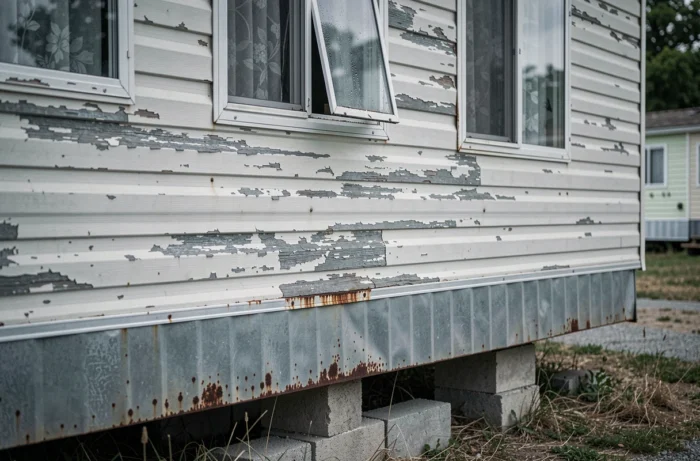
Old mobile home on campsite parcel: the key inspection points
When a conflict arises, it is not the year of manufacture that decides, but the actual condition of the mobile home. There are three areas of verification that managers and courts use.
- The compliance of electrical and gas installations: a mobile home connected for more than fifteen years may have defects in hoses, regulators, or the electrical panel. A recent diagnosis provides the best protection for the owner.
- The maintenance of mobility means: the 2007 decree defines the mobile home as a mobile leisure residence that must retain wheels and a towing bar. If these elements have been removed, the legal status changes and urban planning obligations may apply.
- The visible structural condition: leaks, degraded flooring, detached cladding. A campsite can refuse to maintain a parcel if the general condition jeopardizes the safety or commercial image of the site, provided that this criterion is included in the contract.
A well-maintained mobile home over twenty years old, with up-to-date diagnostics, remains perfectly usable. Conversely, a poorly connected recent model may pose more regulatory problems.
Termination and eviction: what recent case law shows
In 2025, a dispute judged in Draguignan highlighted how courts handle these disputes between mobile home owners and campsite managers. This type of decision reminds us that the judge examines the signed contract, the reasons invoked, and the proportionality of the measure.
The manager cannot proceed with an eviction without respecting the contractual deadlines and without documented legitimate grounds. A threatening letter does not equate to termination: there must be a procedure, a notice period in accordance with the contract, and often a prior formal notice.
For the owner, the most effective response is to gather three elements: the signed rental contract (with its annexes and internal regulations), a condition report of the mobile home carried out by a professional, and written exchanges with the manager. These documents form the basis of any dispute, whether in mediation or before the court.
Concrete recourse in the face of a renewal refusal
The Commission on abusive clauses has already issued recommendations on parcel rental contracts in campsites. If the obsolescence clause does not mention any technical criteria and merely sets a maximum age, it can be challenged before the judge.
One can also contact the Departmental Directorate for the Protection of Populations (DDPP) to report misleading commercial practices when a manager invokes a “law” that does not exist. This report does not always lead to a sanction, but it creates a useful administrative record in case of proceedings.

Mobile home owner without parcel owner: the dependence on the contract
The main trap for a buyer of a second-hand mobile home is underestimating the dependence on the location. You own the mobile home, but not the land. The rental contract may include clauses on subletting, resale on site, or exit conditions that significantly limit the owner’s freedom.
Before any purchase, reading the parcel contract is more decisive than checking the year of the mobile home. A recent model installed in a campsite with restrictive regulations will pose more difficulties than an older model in a leisure residential park with flexible conditions.
The installation rules also vary according to the type of land. The Urban Planning Code reserves the installation of mobile leisure residences for developed sites (classified campsites, PRL). Installing a mobile home on undeveloped private land remains prohibited, regardless of its age. The confusion between caravan and mobile home on this point regularly leads to irregular situations.
The protection of an owner of an old mobile home depends on mastering their contract, maintaining their dwelling in good condition, and knowing the available recourse. The age of the mobile home is just an excuse when the real issue remains contractual.