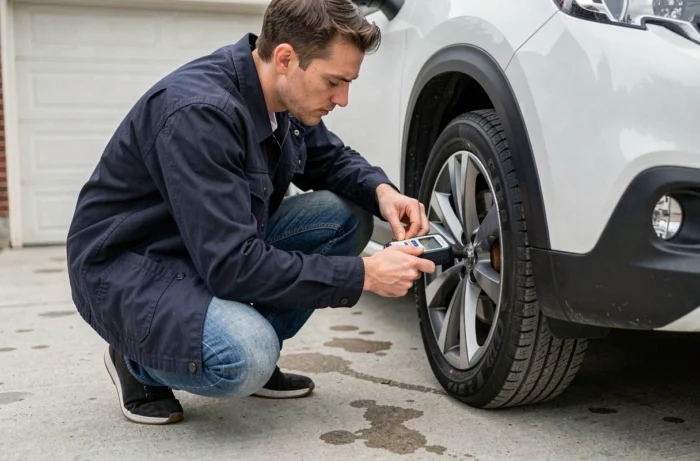
The tire pressure warning light on a Peugeot 2008 indicates a discrepancy between the measured pressure and the reference value recorded by the TPMS system. On this model, the TPMS operates indirectly: it analyzes the variations in wheel rotation speed via the ABS sensors rather than measuring the pressure in each tire.
When a wheel turns faster or slower than expected, the system interprets this as a loss of pressure and lights up the orange warning light on the dashboard.
Indirect TPMS on Peugeot 2008: what the system really detects
The indirect TPMS does not provide pressure values in bars. It continuously compares the rotation speed of the four wheels against each other. An under-inflated tire has a slightly reduced diameter, so it turns faster at the same vehicle speed.
This architecture has a direct consequence on the reset: the system memorizes a reference point at the time of the reset. Any future variation will be measured against this baseline. If the pressure is incorrect at the time the reset is initiated, the system takes this incorrect value as the norm. The warning light will only come back on if there is an additional drop compared to this already distorted threshold.
The procedure to reset the tire pressure on Peugeot 2008 depends on the vehicle generation, and this distinction is rarely specified in online tutorials.

Reset procedure on Peugeot 2008 Mk2 via the touchscreen
On second-generation Peugeot 2008 models (from 2019), there is no physical “SET” button to reset the TPMS. Everything is done through the multimedia system.
Here is the sequence to follow:
- Inflate all four tires when cold, following the values indicated on the label affixed to the driver’s door pillar.
- Turn on the ignition without starting the engine, with the vehicle stationary.
- On the touchscreen, access the “Vehicle” menu, then select “Driving Assistance” (or “Driving” depending on the system language).
- Look for the option “Under-inflation Initialization” (sometimes titled “Initialisation under-inflation”).
- Confirm the reset. The system then records the new reference values.
The warning light may remain on for a few kilometers after the operation. The system needs to drive at a stabilized speed to recalibrate its measurements and confirm that the pressures are consistent.
Difference with the first generation
On first-generation Peugeot 2008 models (2013-2019), some versions have a physical “SET” button located near the steering wheel or in the glove compartment. The logic remains the same (inflate first, reset second), but the access path differs. In the absence of a dedicated button, the procedure also goes through the central screen, with a slightly different menu depending on the version of the onboard software.
Common errors that distort TPMS calibration
Resetting before correcting the pressure is the most common mistake. The driver sees the warning light, initiates the reset from the touchscreen without going to the inflation station, and the system records a pressure that is too low as the new reference.
Another trap: inflating tires when hot. After a trip, the internal temperature of the tire increases and artificially raises the pressure. A reliable check is done with cold tires, meaning after at least two hours of inactivity or less than three kilometers driven at low speed.
The third common case concerns imbalance between axles. The manufacturer’s label sometimes indicates different pressures for the front and rear, especially when loaded. If all four tires are inflated to the same value without checking the label, the system may detect an anomaly even after resetting.
TPMS light coming back on after reset: causes to check
If the warning light comes back on in the days following a properly executed reset, the issue is not related to the procedure. Several causes warrant further diagnosis.
- A slow puncture caused by a nail, screw, or foreign object embedded in the tread. The loss may be a few tenths of a bar per week, sufficient to trigger the light without the tire appearing visually deflated.
- A defective or porous valve, especially on vehicles with aging rubber valves.
- A rim issue (crack, corrosion at the tire bead) that creates a slow air leak between the rim and the tire.
In these cases, the TPMS light fulfills its role by signaling a real loss. Resetting it again will not resolve anything. A visit to a professional with tire dismounting allows for identifying the exact source of the leak.
Asymmetrical wear and false positives
A heavily worn tire or one with irregular wear also alters its rolling circumference. The indirect TPMS may then interpret this difference as a pressure discrepancy. If the warning light returns despite correct pressures, checking the condition of the tires and the geometry of the suspension may be necessary.
The TPMS system of the Peugeot 2008 remains an alert tool, not an onboard pressure gauge. It does not replace regular checks with a reliable gauge, ideally every month and before each long trip. The reset is only valuable if it occurs after a physical check of the pressure, with cold tires, using the correct values for each axle.