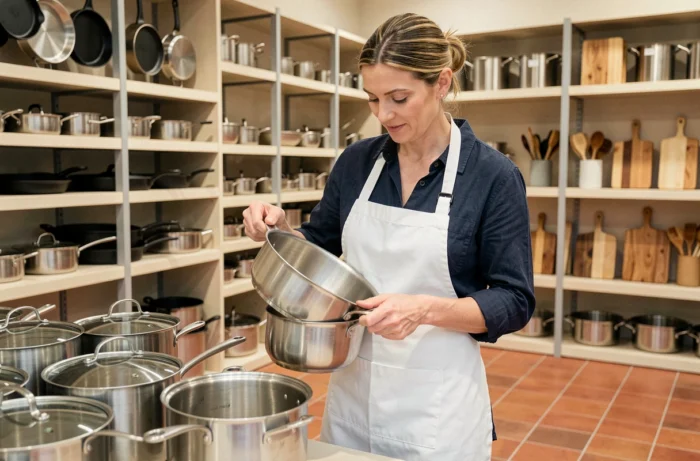
The kitchen equipment market has never offered so many references, materials, and price ranges. Between coatings that change regulatory status and utensils sold in sets whose quality remains difficult to assess, choosing suitable equipment relies on more technical criteria than it may seem. Understanding what distinguishes a good knife, a reliable pan, or a durable accessory requires an interest in materials and their actual behavior in use.
Regulation of food contact materials: what changes for your kitchen utensils
The European framework on food contact materials is tightening. The ban on BPA (bisphenol A) in many materials and articles in contact with food came into effect on January 20, 2025, according to the European Commission. This change does not only concern packaging: it also affects kitchen accessories, storage boxes, and certain coatings.
The “BPA-free” compliance thus shifts from a marketing argument to a regulatory criterion structuring the choice of an utensil. When making a purchase, checking that the manufacturer explicitly mentions this compliance on the packaging or product sheet becomes a useful reflex.
At the same time, the issue of PFAS (perfluoroalkyl substances) in non-stick coatings is the subject of regulatory discussions in Europe. Sweden plans to ban these substances in everyday products, and legislative pressure is increasing. For those looking to explore equipment on the Conseils Cuisine site, this evolution encourages considering alternatives like cast iron, stainless steel, or ceramic, whose material traceability is easier to document.
Kitchen knife: three blades are enough if well chosen
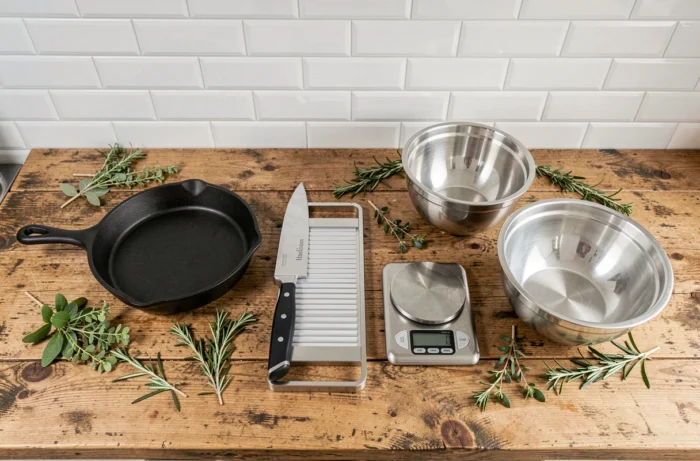
Knife sets including eight or ten pieces give an impression of completeness. In practice, most everyday cuts are made with three knives: a paring knife for small precision tasks, a chef’s knife (or slicing knife) for slicing, dicing, and chopping, and a bread knife for hard crusts.
Fewer knives but better quality steel radically changes the comfort of use. Well-tempered steel retains its sharpness longer and reduces the risk of injury, as accidents occur when forcing with a dull blade.
Maintenance and sharpening
A steel or ceramic honing rod allows you to realign the edge of the blade between uses. Complete sharpening on a stone is still necessary a few times a year depending on usage frequency. Storing knives in a block or on a magnetic strip protects the blades and prevents them from clashing in a drawer.
Frying pan and saucepan: the material determines cooking and lifespan
The choice of a frying pan or saucepan is not limited to diameter or price. The material of the body and that of the coating determine thermal reactivity, compatibility with heat sources, and the longevity of the utensil.
- Stainless steel resists shocks, does not react with acidic foods, and is dishwasher safe without degrading. However, it tends to stick more without fat and requires controlled heating time.
- Cast iron (raw or enameled) offers high thermal inertia, ideal for stews and searing. Its heavy weight and specific maintenance (seasoning for raw cast iron) limit its versatility in daily use.
- Aluminum, often used as the body of a pan with a non-stick coating, heats quickly and remains lightweight. Its lifespan directly depends on the condition of the coating: a scratched or peeling coating must be replaced, regardless of the age of the pan.
Field reports vary on the actual durability of ceramic coatings compared to traditional coatings. Some users notice a loss of non-stick properties after a few months of intensive use, while others maintain their ceramic pans for several years. Cooking temperature and the type of spatula used play a decisive role.
Repairability and actual lifespan of kitchen equipment
The European regulatory trend pushes manufacturers towards greater transparency regarding the composition and traceability of their products. This movement practically favors equipment that is easy to maintain, repair, and replace by parts rather than highly composite items.
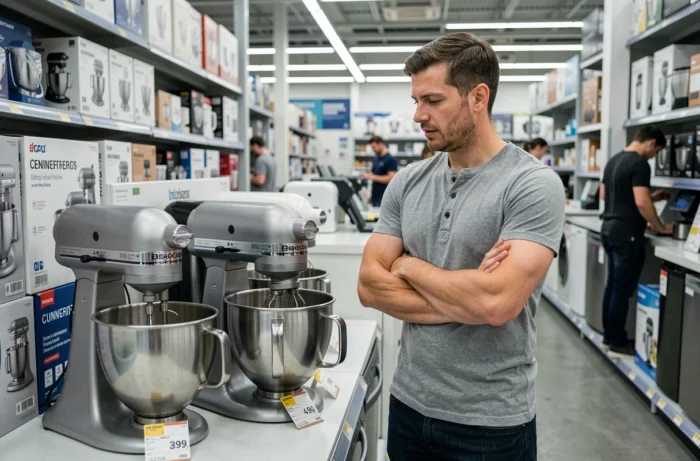
A steam cooker with a replaceable seal, a saucepan handle that is screwed rather than riveted, a knife whose blade can be sharpened on a stone: these details determine whether equipment will last three years or fifteen. Before purchasing, checking the availability of spare parts (seals, handles, lids) from the manufacturer gives a reliable indication of the expected lifespan.
Complementary accessories: the trap of the set
Accessory sets (spatulas, whisks, tongs, ladles) sold in packs of ten or fifteen pieces pose a recurring problem. The quality of each piece mechanically decreases when the overall price remains low. Three or four utensils made of stainless steel or solid wood cover most needs: a spatula, a wooden spoon, tongs, and a whisk.
Wood and stainless steel have the advantage of being inert in contact with food, easy to clean, and durable. Food-grade silicone utensils resist heat and do not scratch coatings, but their quality varies greatly among manufacturers.
Choosing kitchen equipment comes down to balancing the number of pieces and the quality of each. A well-sharpened chef’s knife, a stainless steel or cast iron pan suitable for its heat source, and a few sturdy utensils form a base that covers the vast majority of recipes. The rest depends on specific needs, to be assessed on a case-by-case basis rather than anticipated in bulk.