Home fitness now concerns more than a third of athletes in France according to the 2024 barometer from the Union Sport & Cycle. This practice is no longer a temporary substitute for the gym: it has established itself as a full-fledged training mode. The question remains what distinguishes an effective home routine from a series of disorganized exercises that stagnate after a few weeks.
Progressive overload with body weight: the underutilized lever in home fitness
Most guides on home workouts list exercises (push-ups, squats, planks) without explaining how to force muscle adaptation without adding external load. Body weight remains constant, which poses a concrete problem of progression.
Three mechanisms allow you to bypass this limit without buying any accessories:
- Increase time under tension by slowing down the eccentric phase (descent) of each repetition to four or five seconds, which engages more muscle fibers with the same movement.
- Reduce the base of support to increase difficulty: elevated feet push-ups, Bulgarian squats on a chair, one-arm planks. Each variation increases the relative load on the targeted muscle.
- Decrease rest times between sets (from 90 to 45 seconds) to maintain a higher metabolic fatigue, which stimulates muscle growth even with the same load.
These three variables (tempo, instability, density) form a measurable progression framework. A training log, even on a simple sheet, allows you to note each parameter and quantify progress from week to week.
Additional resources on home training methods are available on the Esprit Sport website, which details several approaches suitable for beginners.
Home fitness session: duration and frequency compared by level
The national campaign “September Move,” led by the Ministry of Health, reminds us of an official benchmark: at least 30 minutes of dynamic physical activity per day for adults. For children and adolescents, this threshold rises to 60 minutes. These durations can be broken up throughout the day, which directly applies to home sessions.
The table below compares three typical profiles to structure a bodyweight training program at home:
| Parameter | Beginner | Intermediate | Advanced |
|---|---|---|---|
| Sessions per week | 3 | 4 | 5-6 |
| Duration per session | 20-30 min | 35-45 min | 45-60 min |
| Rest between sets | 60-90 s | 45-60 s | 30-45 s |
| Sets per muscle group/week | 6-8 | 10-14 | 14-20 |
| Main progression | Technical mastery | Volume and variations | Tempo and intensity |
The gap between beginner and advanced does not lie in the complexity of the exercises. It is found in the total weekly sets per muscle and in the management of rest. A beginner trying to replicate the volume of an advanced practitioner risks overtraining and giving up.
Minimum frequency for progress
Three sessions per week, spaced with a day of rest, are enough for a beginner to observe measurable strength gains over four to six weeks. Below two weekly sessions, the stimulus is too spaced out to provoke significant adaptation.
The challenge is not to multiply workouts but to maintain consistency over several months. Moving from three to four sessions is only justified when recovery between sessions becomes comfortable and progress stagnates.
Micro-breaks and combating sedentariness: a complement to the training program
Health authorities now emphasize active micro-breaks as much as structured sessions. Santé publique France recommends regularly breaking prolonged periods of sitting, including on days when a workout is scheduled.
Specifically, standing up every 30 to 45 minutes for two minutes of movement (walking, stretching, a few squats) does not replace a workout but reduces the harmful effects of accumulated sedentariness throughout the day.
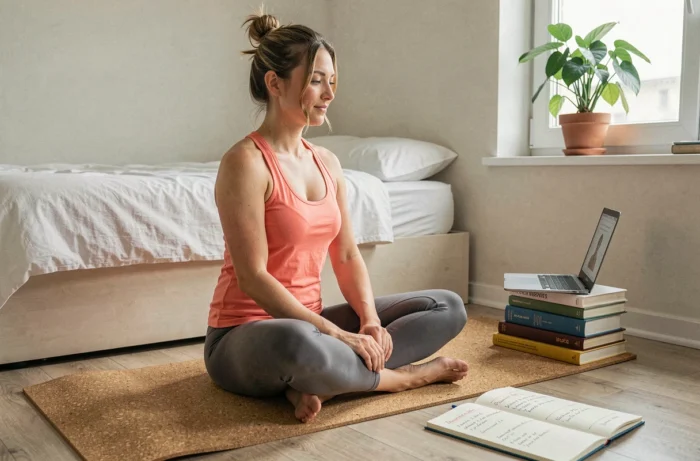
This point changes the way to conceive a home fitness program. A morning or evening session does not compensate for eight hours of inactivity. Integrating short mobility routines between sitting periods complements muscle strengthening work and improves joint recovery.
Bodyweight exercises: hierarchy by effectiveness for beginners
Not all bodyweight exercises are equal for a beginner. Compound movements (which engage multiple joints simultaneously) offer a better return on investment than isolation exercises.
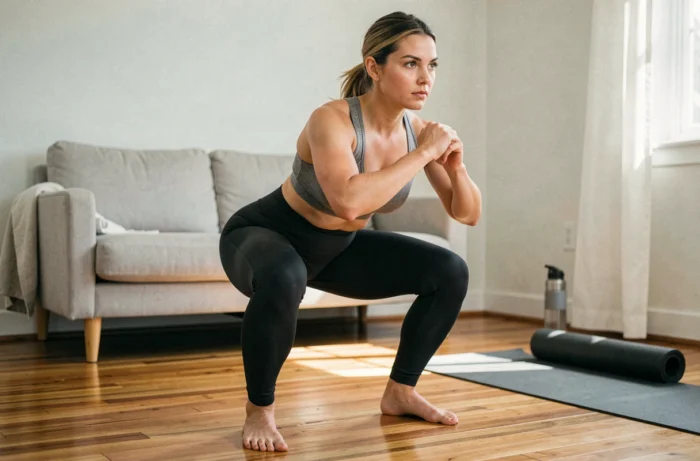
- The squat recruits quadriceps, glutes, and core stabilizers in one movement. It is the first exercise to master technically before any variation.
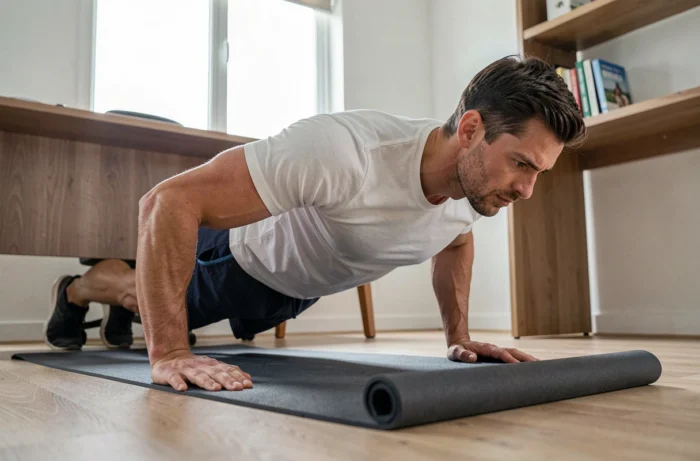
- The push-up engages the chest, triceps, shoulders, and core. Start on your knees if necessary, then progress to the full version.
- The forward lunge works on balance and unilateral strength, correcting muscle imbalances between the right and left legs.
- The front plank strengthens the core without spinal compression, provided you do not arch your lower back.
On the other hand, exercises like classic crunches or lateral raises without weight provide little stimulus to a beginner. Four well-executed compound movements cover the majority of muscle groups and allow for building a solid foundation before adding variations.
Technique before volume of repetitions
A poorly executed squat for 20 repetitions yields fewer results than a controlled squat for 10 repetitions with full range of motion. Filming your sessions with a phone placed on the ground allows you to check knee alignment, movement depth, and back posture.
The number of repetitions only holds value if each repetition adheres to the full range of motion. It is this technical requirement that distinguishes sustainable progression from training that stagnates after a few weeks. The training log remains the best tool to track both volume and execution quality.