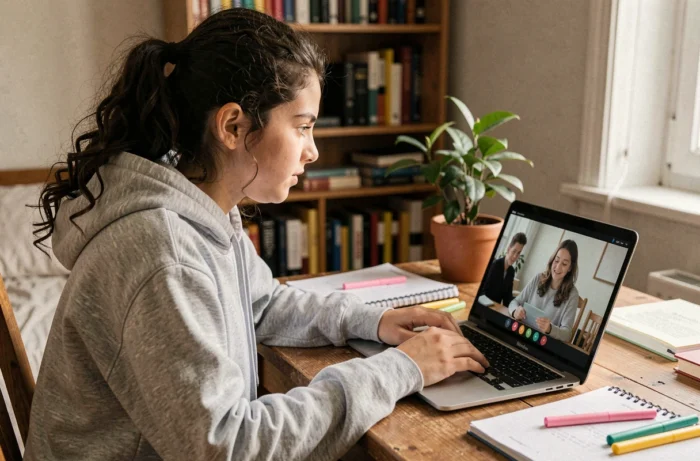
Online tutoring relies on measurable pedagogical mechanisms: personalization of the learning path, frequency of interactions, adaptation of pace. Comparing these parameters with those of traditional home tutoring helps to understand where the real gaps lie for a struggling student.
Educational AI and online tutoring: what the regulations say in 2026
Most online course platforms integrate algorithms to assess a student’s level, propose targeted exercises, or guide them towards an appropriate learning path. Since the gradual implementation of the European AI Act, these automated assessment systems may fall under the category of high-risk AI systems when they determine a student’s appropriate level or contribute to their guidance.
For parents, this creates a concrete selection criterion: does the platform explain how its assessments work? Does it foresee human supervision of the recommendations generated by the algorithm?
At the same time, the CNIL published specific recommendations in June 2025 regarding the use of artificial intelligence in education, aimed at protecting minors’ data. An online tutoring service that respects these frameworks offers families a guarantee that less structured platforms cannot provide. As detailed by the Soutien Adom site for tutoring, difficulties with the teacher in class are one of the frequent triggers for seeking personalized support.
The Institut Evidences, in its analysis of PISA 2025 published in September 2026, emphasizes that the benefit of educational AI depends on the actual activity of the student. If the tool replaces reasoning instead of stimulating it, the educational gain disappears.

Online tutoring or home tutoring: comparative table of formats
Families often hesitate between a home tutor and a teacher via videoconference. The differences are not limited to price.
| Criterion | Home Tutoring | Online Tutoring |
|---|---|---|
| Schedule Flexibility | Fixed slots, planned in advance | Flexible slots, sessions possible in the evening or on weekends |
| Choice of Teacher | Limited to the local geographic area | Access to specialized teachers by subject across the country |
| Personalization | Adapted to the student’s pace | Adapted to the pace, enhanced by automated assessment tools |
| Learning Environment | Student’s home, physical presence | Student’s home, shared screen and interactive resources |
| Responsiveness to a Specific Difficulty | Waiting for the next scheduled slot | Short session possible within a few hours |
| Parental Follow-up | Oral exchange after the session | Written reports, session history, dashboard |
The main gap lies in responsiveness. A student stuck before a math test can get a targeted session that same evening with online tutoring, whereas home tutoring imposes a delay of several days.
Access to Specialized Teachers by Subject
In rural areas or medium-sized cities, finding a competent private tutor in physics-chemistry at the terminal level or in Spanish LV2 can sometimes be an obstacle course. Online tutoring eliminates geographical constraints and allows for selecting a teacher based on their specialty, not their proximity.
Personalized Learning and Academic Difficulties: Where the Difference Lies
Personalization is the key word for all tutoring platforms. In practice, it encompasses very different realities depending on the tools used.
- An automated initial diagnosis identifies gaps by skill, not just by subject. A student in the third grade may master first-degree equations but struggle with fractions, which the class program does not distinguish.
- The frequency of micro-assessments (quizzes after each concept, adaptive exercises) allows for measuring progress over short cycles, sometimes from one week to the next.
- The choice between videoconference sessions with a teacher and independent exercises on the platform offers a hybrid learning experience tailored to each child’s profile.
For a struggling student, this granularity changes the dynamics. Traditional tutoring relies on the teacher’s diagnosis, which remains relevant but is limited by the session time. Digital tools add a layer of continuous analysis.
Trust and Motivation: Difficult Indicators to Quantify
Parents regularly report that their child regains confidence after a few weeks of online support. This gain does not appear in any dashboard, but it translates into observable behaviors: participation in class, reduced stress before tests, autonomy in homework.
The regularity of short sessions contributes more to motivation than a long weekly session. A format of thirty to forty-five minutes, repeated two to three times a week, maintains engagement without causing cognitive overload.
Data Protection for Students: A Selection Criterion Between Platforms
The CNIL’s recommendations from June 2025 place the protection of minors’ data at the center of the evaluation of digital educational tools. In practical terms, this involves several checks for parents:
- Does the platform only collect data necessary for educational tracking, or does it also exploit behavioral data (time spent on each screen, clicks, browsing history)?
- Are the student’s data hosted in Europe, in accordance with GDPR?
- Can the child use the service without creating a profile on a social network or linking a third-party account?
These questions do not appear in the usual comparisons of online tutoring. However, they constitute a objective selection filter between private tutoring platforms.
The European regulatory framework on AI in education will strengthen in the coming years. Choosing a platform now that is transparent about its algorithms and compliant with CNIL recommendations is a way to avoid having to change when requirements tighten. The most effective online tutoring remains that which combines a qualified teacher, mastered adaptive tools, and a data framework respectful of the student.