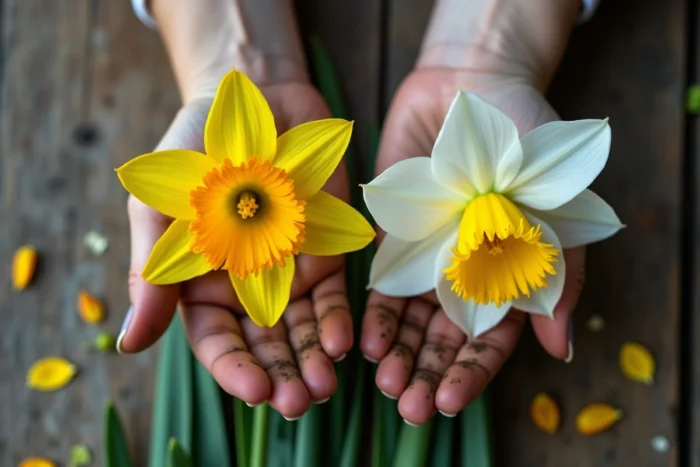
The genus Narcissus includes all the flowers that everyday language refers to interchangeably as “daffodil” or “narcissus.” However, in botany, these two words do not refer to the same plant. Understanding the difference between daffodil and narcissus relies on a few simple morphological criteria, observable directly in the garden, without any special equipment or expertise.
Narcissus jonquilla and Narcissus pseudonarcissus: comparative table of botanical criteria
The confusion arises from the fact that all daffodils are narcissus, but not all narcissus are daffodils. The daffodil in the strict sense refers to the species Narcissus jonquilla. The most common narcissus in French gardens is Narcissus pseudonarcissus, often sold under the name “daffodil” in garden centers.
| Criterion | Narcissus jonquilla (true daffodil) | Narcissus pseudonarcissus (yellow narcissus) |
|---|---|---|
| Leaves | Thin, cylindrical, almost like rushes | Wider, flat, ribbon-like |
| Flowers per stem | Several small flowers per stem | One large flower per stem |
| Trumpet | Short, cup-shaped | Long, well-defined trumpet |
| Fragrance | Very pronounced, sweet | Subtle or almost absent |
| Dominant color | Uniform bright yellow | Yellow, sometimes bicolored (darker trumpet) |
The quickest key remains the foliage: thin, cylindrical leaves indicate the true daffodil. Flat, wide foliage suggests a classic narcissus or a horticultural hybrid.
To delve deeper into the difference between daffodil and narcissus, one must also consider the origin of the bulbs and how they are labeled in commerce.
Labels in garden centers: why the name on the packet is not enough
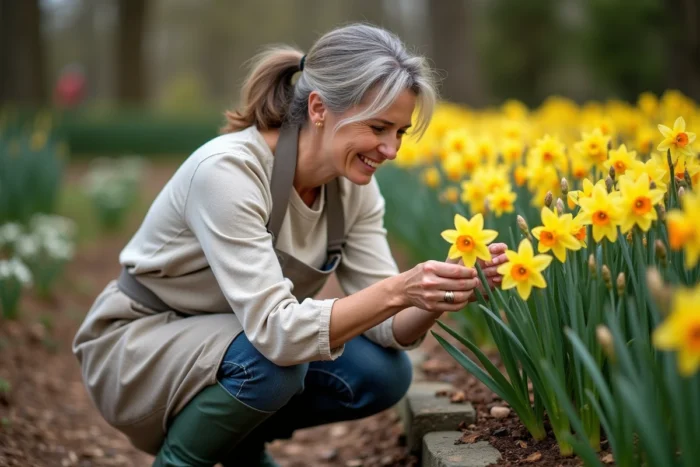
The overwhelming majority of bulbs sold under the label “daffodil” in garden centers are actually hybrid narcissus resulting from horticultural selections. Narcissus jonquilla, the true botanical daffodil, represents a marginal share of public sales.
This discrepancy between the commercial name and botanical reality explains why so many gardeners believe they are growing daffodils when they have planted narcissus. The label sometimes mentions the Latin name, but not always. When it does, it is the most reliable reference.
Three reflexes to check before buying
- Read the Latin name on the label: Narcissus jonquilla confirms a true daffodil, Narcissus pseudonarcissus or a cultivar name (e.g., ‘Ice Follies’, ‘Carlton’) indicates a narcissus or a hybrid.
- Observe the photo: several small flowers per stem point to the Jonquilla section, a large solitary flower with an elongated trumpet indicates a classic narcissus.
- Ask about the horticultural division: the Royal Horticultural Society classifies narcissus into numbered divisions. Division 7 corresponds to daffodils in the botanical sense.
Without this verification, relying solely on the word “daffodil” on a bulb packet amounts to buying blindly.
Foliage, trumpet, fragrance: the three markers in the garden in spring
Once the bulbs are planted and the flowering has occurred, three criteria allow for reliable identification without any tools.
The foliage, the first clue as soon as it emerges
The leaves appear before the flowers. If they are narrow, almost round in cross-section, and resemble a rush (hence the name “daffodil”), the likelihood of encountering Narcissus jonquilla is high. In contrast, flat and wide foliage, ribbon-like in type, indicates a narcissus from the Pseudonarcissus section or a hybrid.
The trumpet, flowering criterion
In the classic yellow narcissus, the central trumpet is as long as the surrounding petals, or even longer. In the botanical daffodil, this crown remains short, forming more of a flat cup. This proportion between trumpet and tepals is a stable marker, even in recent cultivars.
The fragrance, often underestimated
Narcissus jonquilla emits an intense fragrance, detectable from several steps away. Narcissus pseudonarcissus are significantly less fragrant, sometimes odorless. A sweet and powerful fragrance in spring almost always indicates a true daffodil.
Hybrid narcissus in the garden: beyond the question of daffodil or narcissus
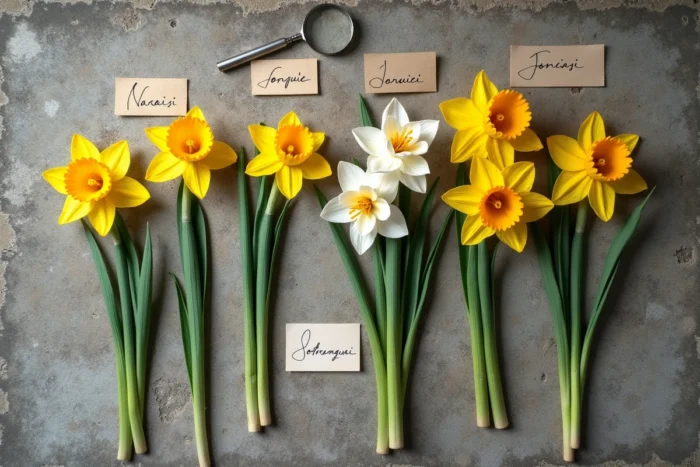
Horticultural breeding programs have produced thousands of cultivars that blur the boundaries between species. Some hybrids combine the fragrance of Narcissus jonquilla with the large solitary flower of Narcissus pseudonarcissus. Others exhibit colors absent in wild species: pure white, salmon orange, pale pink.
For the gardener, the question “daffodil or narcissus?” mainly arises at the time of purchase. Once in the ground, the plant grows in the same way: bulb planting in autumn, flowering in spring, summer dormancy. The requirements for well-drained soil and sunny exposure remain the same for the entire genus Narcissus.
Nonetheless, the distinction retains practical interest. True daffodils (division 7) naturalize well in lawns and produce very fragrant bouquets. Large trumpet narcissus (division 1) provide a stronger visual impact in beds due to the size of their flowers.
The decisive criterion remains the initial one: thin, cylindrical leaves, several small fragrant flowers per stem, short crown. If these three elements are present, it is a daffodil. In all other cases, the term narcissus is botanically more accurate, even if common usage will likely continue to mix the two names for a long time.