A nurse who has been working for several years and wants to transition to physiotherapy quickly faces a practical question: should she start from scratch or is there a regulatory shortcut? The answer is one word: the bridge, but its actual functioning deserves attention.
Bridge from nurse to physiotherapist: what Article 25 of September 2, 2015, concretely changes
The bridge system allows qualified nurses to directly enter an IFMK (institute for training in massage-physiotherapy) in the second year, based on their application. This means going from five years of study to four years. This is significant when one already has a professional life and sometimes fixed expenses.
To be eligible, one must have at least two years of experience as a nurse. The application file is based on the results of the nursing diploma, professional experience, and a well-argued motivation letter. Some IFMKs add an oral interview.
In practice, one submits a file to the targeted IFMK, and each institute manages its own schedule. The number of places available through the bridge remains limited, often just a few positions per class. The selection is therefore tough, and it is better to apply to several institutions simultaneously. Those considering becoming a physiotherapist after transitioning from nursing benefit from preparing their application several months in advance.

PASS, L.AS or STAPS degree: other pathways to IFMK for a nurse
The bridge is not the only option. If the application is unsuccessful or if one prefers to maximize their chances, three other pathways lead to an IFMK.
- The PASS (specific health access pathway): a university year that opens access to MMOPK programs, including physiotherapy. The year is intensive, with a demanding fundamental sciences curriculum.
- The L.AS (degree with health access option): one follows a traditional degree (biology, STAPS, psychology) with a health minor. The advantage is that in case of failure to gain admission to IFMK, one retains their degree.
- The biology or STAPS degree: some IFMKs recruit directly after validation of a complete degree in these fields, without going through the PASS or L.AS.
For a nurse transitioning, the L.AS in biology can be a pragmatic choice. The knowledge gained from the nursing curriculum facilitates the understanding of scientific teachings. Each IFMK has its own criteria and university agreements, which necessitates checking accepted pathways on a case-by-case basis.
2027 health studies reform: what could change for nurses
The health studies reform planned for 2027 restructures access pathways to MMOPK programs around a bac+3 level. Paramedical bridges should be strengthened for professionals who have completed three years of paramedical training.
On paper, nurses find themselves in a favorable position as they already meet this level criterion. Feedback on this point varies, as not all implementing texts have been published yet.
One key point to remember: for professionals already in practice, no immediate changes are planned regarding the current bridge modalities. In other words, there is no need to wait until 2027 to submit an application. Those who are ready now have nothing to gain by postponing.
Training costs in IFMK: public vs private
The financial gap between a public IFMK and a private IFMK is considerable. In a public institute, annual fees are aligned with university fees, amounting to a few hundred euros per year. In a private IFMK, the bill can reach several thousand euros per year, which radically changes the financial equation of a career transition.
One can mobilize the professional transition project (formerly CIF) to finance all or part of the training. The study grant contract, offered by some healthcare establishments, is another option: a hospital finances the training in exchange for a service commitment after graduation. Apprenticeship in IFMK is also developing and allows for a combination of income and training.
Four years of study in IFMK: what the daily life of a transitioning nurse looks like
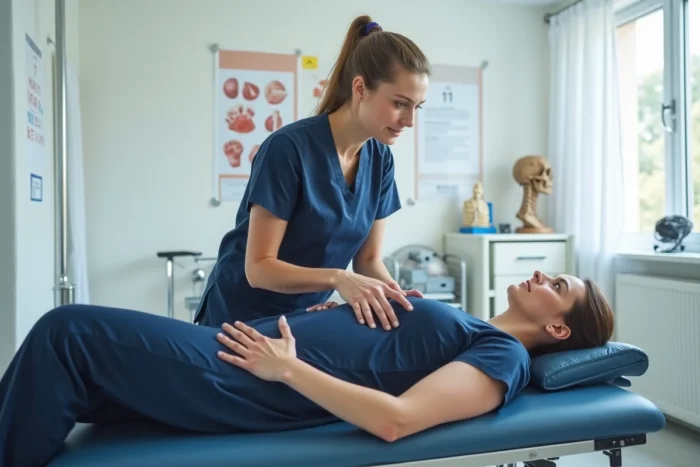
Entering IFMK via the bridge means joining the second-year class. The courses start strong with biomechanics, functional anatomy, and rehabilitation techniques. The clinical background of a nurse is a real advantage for patient relationships and hospital internships.
However, the workload remains heavy. We are talking about a dense university rhythm, with mandatory clinical internships each year. The internships cover various fields: orthopedics, neurology, pediatrics, geriatrics, sports rehabilitation.
Managing financial transition during studies
The majority of transitioning nurses must deal with a loss of income during training. A few strategies often recur in successful pathways: prior savings of at least one year of fixed expenses, occasional work as a temporary nurse on weekends (when the schedule allows), and mobilizing CPF rights.
Anticipating the financial setup before submitting the application helps avoid having to drop out midway. The total cost of the transition is not limited to tuition fees: housing, transportation, and educational materials add up quickly.
Physiotherapy then offers a wide professional autonomy, with the possibility of practicing independently, in rehabilitation centers, or in hospitals. For a nurse seeking more independence in her practice, transitioning to physiotherapy directly meets this expectation. The hardest part remains the four years of study, not what comes after.