
When installing a wall shelf in a narrow hallway that needs to support around ten kilograms of books, the choice of bracket isn’t just about picking the first metal piece you find in the hardware aisle. The type of bracket, its material, and its dimensions determine the strength of the assembly, the load distribution, and its durability over time.
Understanding the differences between models helps avoid unpleasant surprises, such as shelves that end up sagging or furniture that detaches from the wall.
Wall mounting bracket: load and material before aesthetics
The most common case in home DIY is the installation of a shelf or a shelf against a wall. One usually thinks first about style, while the real question is mechanical: what weight will the assembly need to support?
A galvanized steel mounting bracket remains the most common choice for medium loads. It withstands the ambient humidity of a kitchen or bathroom without rusting prematurely. For a wall support intended to hold heavier items (small appliances, dish collections), one opts for reinforced brackets, sometimes referred to as “heavy-duty,” with a thicker metal section and more numerous fixing holes.
Aluminum is suitable for light and decorative installations. It has the advantage of being visually more discreet, but its mechanical strength is still inferior to that of steel. To determine precisely the position of the bracket on Normandie Libre based on the type of wall and the intended load, several parameters come into play, starting with the choice of appropriate anchors for the support.
A point often overlooked: the bracket is only as good as its fixation to the wall. On drywall, even a solid bracket will fail if the anchors are not suitable. On concrete or solid brick, the safety margin is much more comfortable.
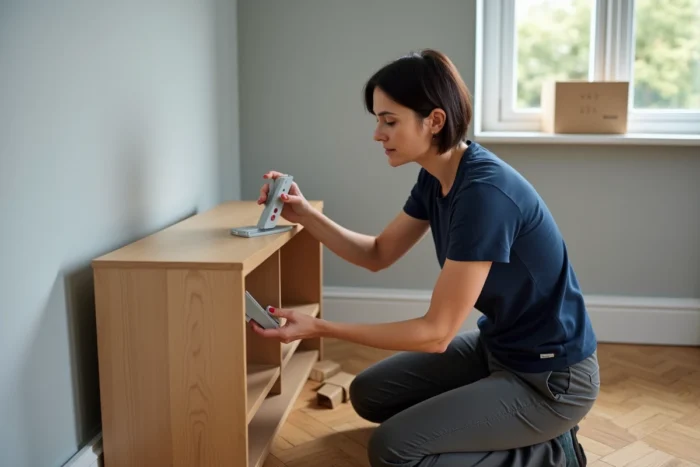
Carpenter’s square for marking: angle precision above all
We completely change the register with the carpenter’s square. Here, nothing is fixed; we measure and mark. This tool is used to check that an angle is indeed right, to draw perpendicular lines on a board, or to control the squareness of a frame being assembled.
The simple square, with its blade and heel forming a 90-degree angle, covers the majority of needs in common carpentry. It is placed against the edge of a piece of wood, and we mark. Nothing could be more straightforward.
False square and combination square: when 90 degrees isn’t enough
The false square (or butterfly square) allows you to measure and reproduce any angle, acute or obtuse. Its blade pivots and locks at the desired angle. It is typically used to transfer an existing angle (a wall that is not straight, a diagonal assembly) onto a piece to be cut.
The combination square goes further: it generally includes a graduated ruler, a bubble level, and the ability to mark at 45 degrees in addition to 90. It is a multifunctional tool appreciated in the workshop, but its precision greatly depends on the quality of manufacturing. Entry-level models sometimes exhibit play in the locking mechanism, which limits their reliability.
Metal connectors for wood construction: a structural assembly logic
The term “bracket” also encompasses a whole family of metal pieces used in framing and wood construction. We then speak more of metal connectors, a terminology that reflects a more technical use than simple fixing DIY.
These pieces include:
- The framing bracket (or angle for joist), which connects a joist to a supporting beam. Its load capacity is designed for structural loads, not for a simple shelf.
- The multi-hole bracket, drilled with numerous holes to adapt to different screwing and bolting configurations. It is found in the assemblies of pergolas or wooden terraces.
- The concrete bracket, designed to anchor a wooden element into a concrete structure, with sealing legs or chemical fixings.
This “connection engineering” approach is distinctly different from the general public hardware aisle. The sizing of a connector depends on permanent loads and dynamic forces (wind, snow, traffic) that the structure will need to withstand. One does not choose a joist angle the same way one chooses a shelf support.
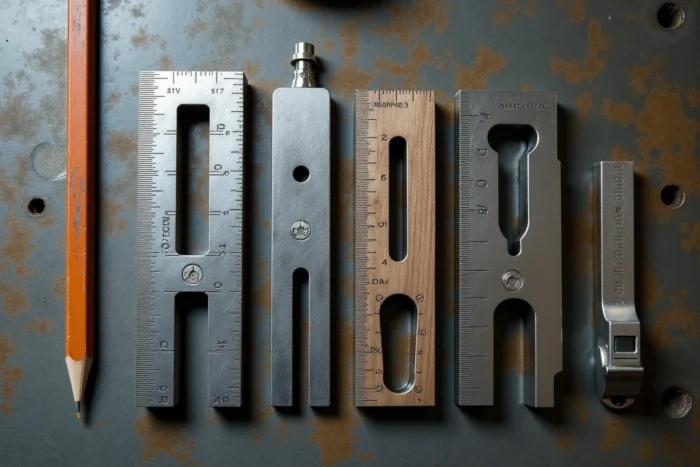
Decorative bracket for shelf: when the support becomes visible
In a living room or bedroom, one sometimes wants the bracket to be visible and contribute to the room’s style. Decorative brackets come in matte black metal, brushed brass, wood, or various geometric shapes.
The classic pitfall: choosing a decorative bracket that is too thin for the intended load. A bathroom shelf holding a few bottles poses no problem. However, a kitchen board loaded with glass jars requires a support whose section and material are designed for that use.
Before buying, one should check two things:
- The depth of the bracket relative to the width of the shelf. The bracket should cover at least two-thirds of the depth of the top to avoid tipping.
- The material and thickness of the metal. A thin folded steel bracket will deform under a load that the same model in thicker steel would support without issue.
- The type of wall and associated anchors. On drywall, expansion anchors or Molly anchors are the minimum; feedback varies on this point depending on the thickness of the partition.
How to choose between marking square and mounting bracket
The confusion between these two families of brackets arises regularly. A carpenter’s square fixes nothing; it measures and marks. A mounting bracket measures nothing; it assembles and supports.
In practice, a DIY project often involves both. To mount wall shelves, one first uses a marking square to mark the drilling points on the wall, then mounting brackets to support the shelves. Confusing the two leads to approximate or undersized assemblies.
The choice of the right type always depends on the specific situation: nature of the wall, weight to be supported, angle to be respected, desired visual result. Starting from the on-site constraints rather than the product catalog is the safest method to avoid having to start all over again.