
A newborn sleeps, eats, and demands to be changed. Their real needs can be categorized into a few groups, far fewer than what lengthy lists suggest. Taking care of a baby from birth means first distinguishing what is necessary from day one from what can wait several weeks.
Baby bed and mattress safety standards: what shopping lists overlook
You’ve spotted a nice crib online. Before finalizing the purchase, check one specific point: compliance with the European standard EN 716, which is the reference for baby and young children’s beds. This standard governs the spacing of the bars, the depth of the mattress, and the sturdiness of the structure.
For the mattress, the standard to look for is NF EN 16890. It defines specific firmness, size, and safety criteria for children’s bed mattresses. A mattress that is too soft or slightly too small leaves a gap where the infant’s face can get trapped.
Specifically, when choosing a mattress, it must fit perfectly within the bed’s interior dimensions, with no gaps on the sides. On Bulla Bébé, you will find guidelines to help you choose among childcare equipment that meets these requirements.
Another useful reflex: check that the second-hand bed being offered to you has not been recalled by the manufacturer. Product recalls are published on the DGCCRF website.
Safe sleeping for infants: actions that matter more than the equipment
Equipment is not everything. How you lay your baby down has a greater impact on their safety than the brand of the bed. The basic rule is simple: always lay the baby on their back, in an empty bed.
No blanket, no pillow, no bumper, no stuffed animal. A sleep sack or a suitable sleeping bag for the season is enough. The room temperature should ideally be between 18 and 20 °C.
Why emphasize this point in an article dedicated to essentials? Because many parents buy bedding accessories (baby wedges, bed reducers, thick sleeping bags) that go against safety recommendations. The fewer items you put in the bed, the better.
Co-sleeping: a strict framework
If you opt for a co-sleeping crib, it must be securely attached to the parental bed, with no gap between the two mattresses. Co-sleeping in a shared bed (in the same bed as the parents) is discouraged by French health authorities due to the risk of suffocation.
Newborn feeding: breastfeeding, bottles, and the bare essentials
Breastfeeding or formula, the choice belongs to the parents. In both cases, the list of equipment remains short if you avoid premature purchases.
For breastfeeding, the essentials boil down to a few items:
- Two or three soft, non-wired nursing bras for comfortable support day and night
- Nursing pads (washable or disposable) to absorb milk leaks between feedings
- A breast pump, which you can rent at a pharmacy with a prescription instead of buying outright
For bottles, four to six bottles and a bottle brush are sufficient at the start. Choose a first-stage infant formula, asking for advice from your maternity ward or pediatrician. There’s no need to stock up on several brands in advance.
One often overlooked point: sterilization. It is no longer systematically recommended in France if you clean the bottles with hot soapy water right after each use. Therefore, a sterilizer is not a priority purchase.
Infant care and hygiene: truly useful products from birth
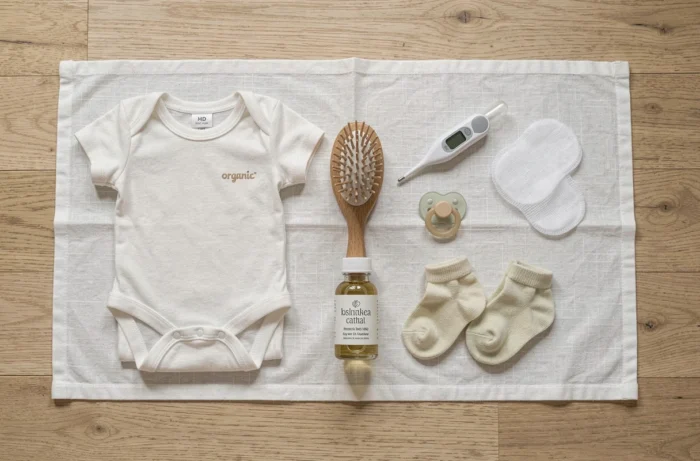
A newborn’s bath does not require an arsenal of cosmetics. Pediatric dermatologists recommend limiting products to the bare minimum to preserve the infant’s skin barrier.
Here’s what is truly useful:
- A moisturizing soap or an oleocalcareous liniment for the body and diaper area
- Physiological saline in single-use vials for cleaning the nose and eyes
- Sterile compresses for umbilical cord care, until it falls off
- A diaper cream, to be applied only if redness appears
One cleansing product is sufficient for the body and hair. The “newborn special” ranges with five or six different bottles are more about marketing than dermatological need.
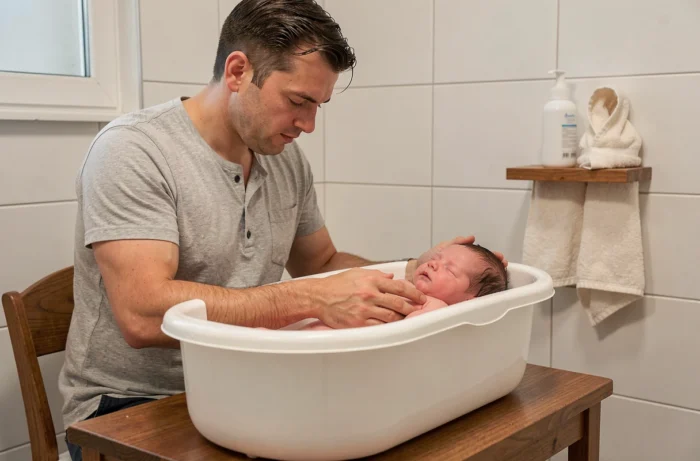
A classic rigid bathtub works very well. A clean large basin will also do for the first few weeks. How often to bathe? Two to three baths per week are sufficient for an infant who is not actively getting dirty. The rest of the time, a warm washcloth bath is appropriate.
Mandatory vaccination for infants: the vaccination schedule 2025
Since January 1, 2025, France has expanded the mandatory vaccination requirements for infants. Vaccination against meningococci ACWY and meningococcus B is now mandatory, in addition to the vaccines already listed in the schedule.
This information does not appear on any shopping list, but it is part of the essentials of birth. As soon as you leave the maternity ward, schedule the first medical appointment with your pediatrician or family doctor to plan the vaccination schedule.
The health booklet given at the maternity ward contains the pages dedicated to tracking vaccinations. Keep it accessible: it will be requested at every consultation and when registering for daycare or with a childminder.
Anticipating medical appointments
The first vaccines are administered as early as two months. Make an appointment before birth if your pediatrician has a long waiting list. It’s a preparation reflex as concrete as setting up the crib or washing the bodysuits.
Welcoming a baby ultimately relies on little equipment but on well-informed choices. A compliant bed, an empty sleeping space, a few care products, the essentials for feeding, and an up-to-date vaccination schedule cover the essentials for the first weeks.